Carrier Furnace Repair in Burbank
Fast take: Burbank Carrier HVAC repairs Carrier 59-series and 58-series gas furnaces across Burbank, CA - Magnolia Park, Burbank Hills, Chandler Park, the Media District, and ZIPs 91501-91523. Call (213) 277-7557 or book online for no-heat lockouts, igniter faults, flame-sensor failures, pressure-switch faults, and high-limit trips.
By the numbers
- Carrier furnace lines: 59-series condensing, 58-series 80 percent, Infinity, Performance, and Comfort gas furnaces.
- Common repairs: hot-surface igniter, flame sensor, pressure switch, inducer, gas valve, high-limit, and blower/ECM faults.
- Flash-code focus: 13/33 limit, 14 ignition lockout, 31 pressure switch, 34 ignition proving, 26 rollout safety.
- Typical 2026 SoCal repair lanes: flame sensor or igniter $120 to $450; pressure switch or inducer $200 to $900.
- Service area: all Burbank ZIPs, 91501, 91502, 91504, 91505, 91506, 91523.
- Independent shop; in-warranty Carrier covered parts go to authorized service first.
- Hours: Mon-Sat 7am-7pm; emergency calls anytime.
What does Carrier furnace repair cover?
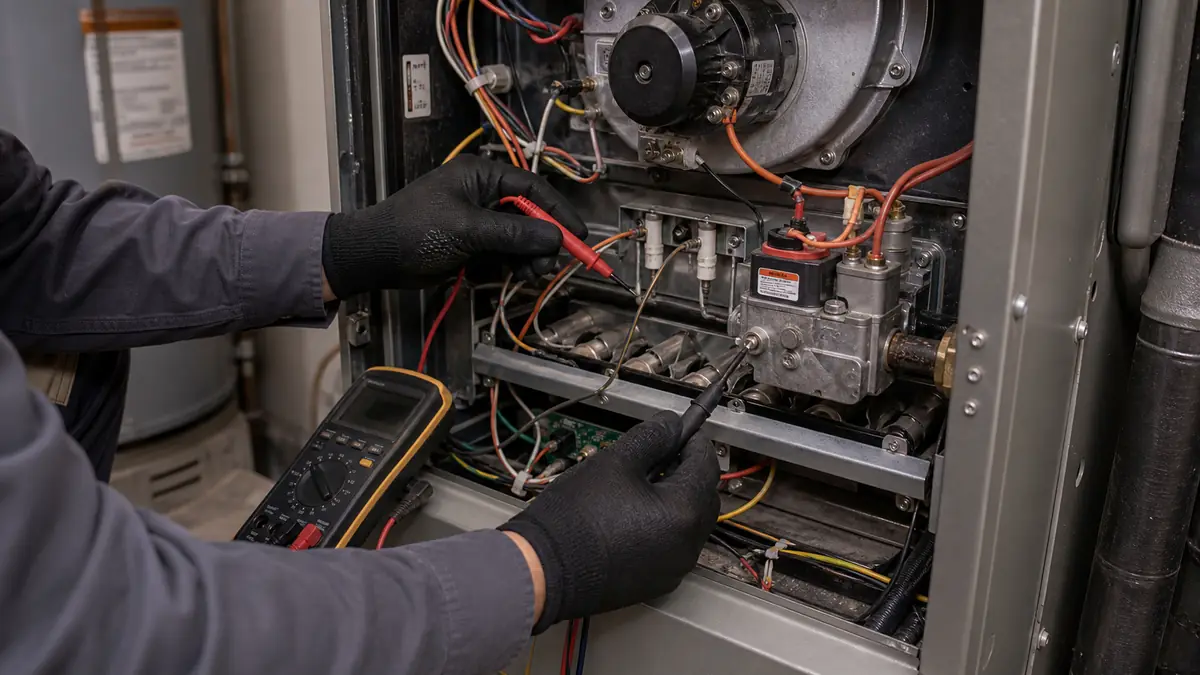
Most Burbank homes with central HVAC run a split system: a Carrier condenser outside and a 59-series or 58-series gas furnace inside that also carries the blower for cooling. Furnace repair is the heating side of that package. We diagnose ignition lockouts, flame-sense failures, pressure-switch faults, inducer problems, high-limit trips, rollout safety trips, and blower faults that affect both heat and AC.
The first cold week exposes dormant parts. A furnace can sit quiet all summer, then the igniter cracks, the flame sensor oxidizes, or the pressure-switch tubing sticks the first time Magnolia Park or Burbank Hills drops into the 40s. That is a repair visit, not a replacement pitch, unless the heat exchanger or rollout safety says otherwise.
| Symptom / code | Likely first check | Cost lane |
|---|---|---|
| 14 ignition lockout | Hot-surface igniter, gas supply, flame signal | $150-$450 |
| 34 ignition proving failure | Flame sensor cleaning or replacement | $120-$350 |
| 31 pressure switch | Inducer, flue, pressure-switch hose, blocked vent | $200-$900 |
| 13 / 33 limit fault | Filter, return airflow, blower, duct restriction | $120-$700 |
| 26 rollout | Heat exchanger, burner, venting safety | Shut down and inspect |
| Blower does not run | ECM/PSC motor, capacitor, control board | $300-$2,300 |
How do we diagnose a Carrier furnace?
We start with the control board, not the parts bin. On a Carrier furnace the amber LED reports a two-digit code, and an Infinity control may show the fault in plain language. Then we walk the heating sequence: inducer starts, pressure switch closes, igniter glows, gas valve opens, flame proves, blower starts, limit stays closed. The failed handoff names the repair.
That keeps the ticket honest. A dirty flame sensor and a bad gas valve can look similar to a homeowner, but they do not meter the same. A high-limit lockout can be a clogged filter, a failing blower, or undersized Burbank ductwork. A pressure-switch code can be a cracked hose instead of an expensive inducer. We show the reading and quote the specific part before we install it.
What changes the quote in a Burbank home?
The same Carrier furnace code can price differently in Magnolia Park than it does in a hillside Burbank Hills garage because access, venting, and the shared blower all change the labor. A furnace in a tight hallway closet may take longer to pull the burner assembly or inducer than an attic platform with clean access. A 91505 ranch with older returns may need airflow correction after a high-limit trip, while a Media District condo may have a compact horizontal furnace where the part itself is cheap but access is the hard part.
We separate the quote into three buckets so the decision is clear. The first bucket is the failed part: igniter, flame sensor, pressure switch, inducer, gas valve, blower motor, or board. The second bucket is the reason it failed: dirty filter, blocked return, condensate issue on a condensing furnace, vent restriction, or electrical connection. The third bucket is the risk level. A nuisance ignition lockout can usually be repaired and verified. A rollout trip, flame rollout, or heat-exchanger concern is a safety stop, not a normal repair ticket.
That structure matters for owners comparing furnace repair with Carrier AC repair or a future AC replacement. The furnace blower is also the cooling blower, so a bad ECM motor can affect both winter heat and summer airflow. When that shared part is expensive, we show the repair number next to replacement paths rather than pretending the heating and cooling systems are unrelated.
What can you check before a furnace visit?
A homeowner can safely check a few things before scheduling. Set the thermostat to heat and raise the setpoint at least 3 degrees above room temperature. Replace a dirty filter if it is visibly loaded. Make sure the furnace switch and breaker are on. If the furnace has a sight glass, count the amber LED flashes before cycling power and write the number down. That flash code is useful because some boards clear the stored fault after power is reset.
Do not bypass a door switch, tape down a safety switch, reset a rollout switch repeatedly, or keep relighting a furnace that smells like gas. Do not pull the burner door while the furnace is trying to fire. If you hear the inducer run, see the igniter glow, and then the burner shuts off after a few seconds, that is a clean clue for flame-sense or ignition proving. If the blower runs but the burner never starts, the first checks move toward limits, pressure switch, or control voltage. Those observations help us load the right part without asking you to work inside the cabinet.
If you are still deciding whether this is a service call or a research problem, use the Carrier no-heat guide for code meanings and then come back here to schedule the repair. For homes thinking about dropping gas heat, the Carrier heat pump page explains the electric alternative in Burbank's mild winter climate.
Repair the furnace, replace it, or move to a heat pump?
Repair is the default for normal ignition and sensor failures. Replacement enters if the heat exchanger is cracked, rollout is recurring, or the furnace is old enough that a major board or blower repair is throwing good money after bad. A heat pump enters when the AC is also aging, because Burbank's mild Zone 9 winter lets a Carrier heat pump cover heating while replacing summer cooling at the same time.
For symptom details, read the Carrier furnace not heating guide. If the shared blower is affecting cooling too, compare Carrier AC repair. If you want the electric path, start with Carrier heat pumps and the SEER2 and rebates briefing.
Common questions
What Carrier furnace parts fail most often in Burbank?
Hot-surface igniters, flame sensors, pressure switches, inducer assemblies, high-limit switches, and the shared blower/ECM are the common ones. Mild Burbank winters let furnaces sit idle for months, so ignition parts often fail on the first cold morning.
What is the difference between furnace repair and the no-heat page?
This page is the service page for booking Carrier furnace repair in Burbank. The no-heat page is the symptom guide that explains flash codes and what they mean. If you are ready to schedule, start here; if you are trying to understand a code, read the no-heat guide.
Can a dirty filter really shut down my furnace?
Yes. Low airflow overheats the heat exchanger and opens the high-limit circuit, which appears as a 13 or 33 limit fault on many Carrier boards. We replace the filter, measure airflow/static pressure, and check whether the blower or ductwork is the deeper cause.
Is a rollout switch trip safe to reset?
No. Rollout can indicate flame leaving the burner box or a heat-exchanger/venting problem. We shut the furnace down, inspect the heat exchanger and venting, and only relight if the safety issue is cleared.
Should I repair a gas furnace or replace it with a heat pump?
If the furnace only needs an igniter or flame sensor, repair it. If the furnace is old, unsafe, or the AC is also near end of life, price a Carrier heat-pump replacement beside the furnace repair. Burbank's mild Zone 9 winters make heat pumps practical.