Carrier Furnace Not Heating in Burbank
Fast take: Burbank Carrier HVAC diagnoses no-heat 59/58-series Carrier furnaces across Burbank, CA - Magnolia Park to Burbank Hills (91504) - reading flash codes 13, 14, 31, and 34; call (213) 277-7557 or book online. Most lockouts trace to a worn hot-surface igniter, a dirty flame sensor, or a stuck pressure switch.
By the numbers
- We service Carrier 59-series condensing and 58-series 80 percent furnaces, including Ultra-Low NOx CA models.
- Most common no-heat cause: worn hot-surface igniter or dirty flame sensor.
- Key flash codes: 13 limit lockout, 14 ignition lockout, 31 pressure switch, 34 ignition proving, 26 rollout.
- Igniter or flame-sensor repair: typically $150-$450.
- A code 26 rollout means we inspect the heat exchanger before relighting (CO safety).
- Service area 91501-91523; hours Mon-Sat 7am-7pm; emergency calls anytime - emergency no-heat answered anytime.
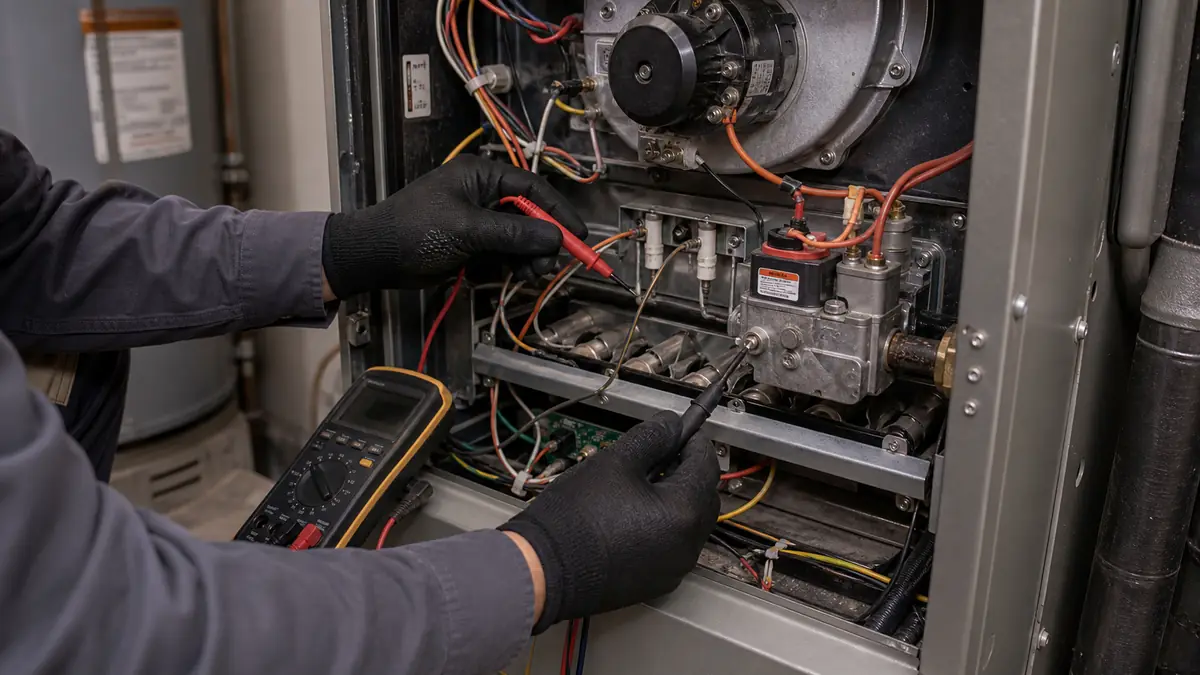
What stops a Carrier furnace from heating?
A Carrier furnace lights in a strict chain of handoffs. The inducer spins up to establish draft, the pressure switch closes to confirm it, the hot-surface igniter heats to a glow, the gas valve opens onto that glow, and finally the flame sensor verifies a real flame is present. Miss any one handoff and the control board halts the sequence and flashes a fault. Because Burbank's mild Climate Zone 9 keeps furnaces idle most of the year, the parts that carry those handoffs - igniter, flame sensor, pressure switch - tend to give out the moment the first cold snap calls on them. The table below maps the common Carrier codes to the part and the fix.
| Flash code / symptom | Likely cause | Cost lane |
|---|---|---|
| 14 ignition lockout | Worn hot-surface igniter or no gas | $150-$450 |
| 34 ignition proving failure | Dirty/weak flame sensor | $120-$350 |
| 31 pressure switch | Inducer, blocked flue, stuck switch | $200-$600 |
| 13 / 33 limit lockout | Overheating: dirty filter, low airflow | $120-$500 |
| 26 rollout switch | Possible cracked heat exchanger - safety | Inspect first; varies |
How does a Carrier no-heat diagnosis go step by step?
We work the ignition sequence in order, because the board locks out at the first broken link. The first move is to read the stored fault: on a 59/58-series furnace the amber control LED flashes a two-digit code (short flashes for the first digit, long for the second), and on an Infinity system the touchscreen spells it out in plain language alongside the number. From there we trace the chain. We watch the inducer spin up and confirm the pressure switch closes (an open switch throws 31), meter the hot-surface igniter for a glow and continuity (14 means it never lit), and check the flame sensor's microamp signal - a sooted or weak sensor reads low and drops the flame after a few seconds, which surfaces as a 34 ignition-proving failure. We verify the gas valve energizes and reads the right manifold pressure, then confirm the high-limit and rollout switches are closed (13 or 33 for limit, 26 for rollout). Each reading either clears a suspect or names the failed part, so the quote names a specific component rather than a guess.
What can I check before calling?
A few safe checks. Confirm the thermostat is set to heat and the temperature is above room temp. Replace a clogged filter - low airflow trips the high-limit (code 13/33) and starves the furnace. Make sure the furnace door panel is fully seated, since a loose panel opens the door switch and kills power. Check that the gas is on at the appliance. If it still locks out, read us the flash code and stop there - igniters and gas valves are not DIY parts.
When is no-heat a safety issue?
The rollout switch (code 26) is the serious one. It trips when flames roll out of the burner box instead of drawing up the heat exchanger, which can point to a cracked or blocked exchanger - and a cracked exchanger can leak combustion gases including carbon monoxide. We do not just reset it. We shut the furnace down, inspect the heat exchanger, and only return it to service if it is sound. On older 58-series 80 percent furnaces in pre-war Burbank homes, this inspection matters.
Common questions
My Carrier furnace tries to start then shuts off - what is that?
That short-cycle-and-lockout pattern is usually the ignition train. The furnace attempts ignition, fails to prove flame, retries a set number of times, then locks out - a code 14 ignition lockout or a 34 ignition-proving failure. The usual culprits are a worn hot-surface igniter or a dirty flame sensor that cannot detect the flame. Both are common, affordable parts.
What does a flashing light on my Carrier furnace mean?
The amber LED behind the access panel flashes a two-digit code - count short flashes for the first digit, long flashes for the second. 13 is a limit-circuit lockout (overheating), 31 is a pressure-switch fault, 33 is a limit fault, 34 is ignition proving, and 26 is a rollout switch that can signal a cracked heat exchanger. Read it to us and we often know the part before arriving.
Is a no-heat Carrier furnace dangerous?
A rollout switch trip (code 26) is the one to take seriously - it can indicate a cracked or overheated heat exchanger, which is a carbon-monoxide concern, so we shut the unit down and inspect before relighting. Most no-heat calls are benign ignition or pressure-switch issues, but we always verify the safety circuit before returning the furnace to service.
Why does my furnace fail on the first cold Burbank morning?
Because it sat unused all summer. A flame sensor oxidizes, an igniter that was marginal in spring finally cracks, or a pressure switch sticks after months idle. The first 45 F Burbank morning in November is when those latent faults surface all at once - which is exactly why a fall heating tune-up pays off.
Related: Carrier furnace repair in Burbank, fall heating tune-ups, emergency service, and Carrier heat pumps (an electric alternative to gas heat).