Carrier Error Codes in Burbank
Fast take: Burbank Carrier HVAC reads and clears Carrier furnace and AC fault codes across Burbank, CA - from Magnolia Park to Burbank Hills (ZIP 91505) - including the common 13 limit lockout and 14 ignition lockout; call (213) 277-7557 or book online and we name the failed part before we quote it.
By the numbers
- Furnace flash codes show on the amber control-board LED (58/59-series); Infinity codes show on the wall touchscreen.
- Two most-searched heating codes here: 13 limit lockout and 14 ignition lockout.
- Read order: count short flashes (first digit), then long flashes (second digit).
- Airflow-driven codes (13, 33) start at a $150-$600 fix; ignition codes (14, 34) usually $150-$400.
- A rollout trip means we inspect the heat exchanger before relighting (CO safety).
- Service area 91501, 91502, 91504, 91505; hours Mon-Sat 7am-7pm; emergency calls anytime.
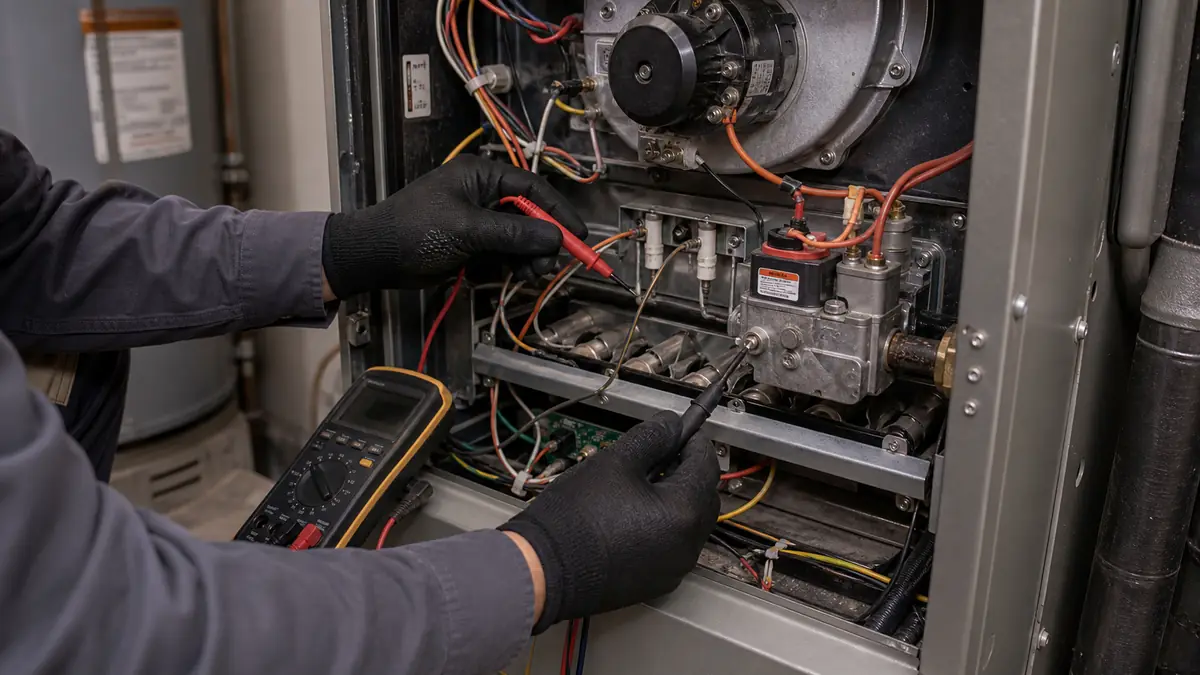
What do Carrier error codes actually tell you?
A Carrier code is the board pointing at the exact handoff that failed, not a vague "something is wrong" light. Every heat cycle runs a fixed sequence: the inducer spins up, the pressure switch confirms draft, the igniter glows, the gas valve opens, and the flame sensor verifies a real flame. The control watches each step, and the instant one step does not complete, it stops and stores a number for it. That is why a code is useful - it converts a dead furnace into a named subsystem. In Burbank's Climate Zone 9, where the southeastern San Fernando Valley floor keeps a furnace idle most of the year and works the AC hard from June through September, the codes you see cluster predictably: ignition and airflow faults on the first cold mornings, electrical and communication faults during the summer heat run. The table below is the working list we keep in our heads on Carrier calls here.
| Code | What it means | First check |
|---|---|---|
| 13 | Limit-circuit lockout - the high-limit opened too many times from overheating | Replace the filter; check for closed registers and a dirty blower wheel |
| 14 | Ignition lockout - the furnace failed to prove flame after its retries | Inspect the hot-surface igniter and the gas supply |
| 31 | Pressure-switch / draft fault - the inducer is not proving draft | Clear a blocked flue or condensate trap; test the inducer and tubing |
| 33 | Limit-circuit fault - recurrent overheating short of a full lockout | Same airflow path as a 13: filter, ducts, blower |
| 34 | Ignition-proving failure - flame lit then dropped out | Clean or replace the flame sensor; check the ground and gas pressure |
| 24 | Secondary-voltage fuse open - a short blew the 3-amp board fuse | Find the 24V short, replace the fuse |
| 178 | Indoor communication fault (Infinity) over the A-B-C-D wiring | Inspect the four-wire comm run and the indoor board |
| 73 | Voltage sensed at the run capacitor with no compressor call | Trace the contactor and run-cap wiring |
Two of these get the most calls in Burbank, so each has its own deep walkthrough: the Carrier 13 limit-circuit lockout and the Carrier 14 ignition lockout. Both pages cover the readings, the homeowner-safe checks, and the local cost.
How do we read codes on a Carrier system?
We start by matching the display to the equipment, because Carrier shows codes two different ways. On a single-stage or two-stage 58- and 59-series furnace, the diagnostic LED behind the lower door blinks a two-digit number - short flashes for the tens digit, long for the ones - and the legend is printed right on the door label. On an Infinity or Greenspeed communicating system, the wall control stores a fault history in plain text, so we pull the last several events with timestamps and watch whether a code repeats or fired once. Either way, the code only narrows the field; the meter settles it. For an ignition code we put a clamp on the igniter and a microamp meter on the flame-sense lead. For an airflow or limit code we measure external static pressure and inspect the filter, coil, and blower wheel. For a pressure-switch code we check the inducer draft and the sensing tubing. The number tells us where to point the instrument, and the instrument names the failed part - which is how the quote ends up specific instead of a parts-cannon guess.
How does Burbank's housing stock change which codes show up?
The building tells you a lot before the panel comes off. Burbank's older core - the 1920s-1940s Spanish and Tudor cottages and California bungalows around Magnolia Park and the Rancho Equestrian District - often runs an 80 percent 58-series furnace squeezed into a tight closet or a hall platform, with undersized return ducts. That combination breeds airflow codes: a single dirty filter starves the return and trips a 13 or 33 limit lockout fast. Post-war minimal-traditional and ranch tract homes in Chandler Park tend toward longer duct runs and the same limit-circuit pattern when a register gets closed off. The newer hillside rebuilds in Burbank Hills more often carry Infinity or Greenspeed equipment, which means the codes shift to the communication and inverter family - 178 across the indoor A-B-C-D wiring, 73 on the cooling side. Knowing the house style lets us walk in already expecting the likely code, which shortens the diagnosis.
How do we fix the codes once they're read?
We fix the cause the code points at, then confirm the fix by running a full cycle and watching the code stay clear. An airflow lockout (13 or 33) gets a new filter, a duct and register check, and a blower-wheel cleaning if it is caked; if the high-limit switch itself opened early we replace it. An ignition lockout (14) gets a metered igniter and a verified gas supply, and a proving failure (34) gets the flame sensor cleaned or replaced and its ground checked. A pressure-switch fault (31) means clearing a blocked flue or condensate trap and testing the inducer before we ever condemn the switch. Communication codes (178, 179) start at the wiring and terminals, since a loose comm conductor mimics a dead board for a fraction of the cost. After the repair we cycle the system, clear the stored fault, and verify the readings sit in spec - draft proven, microamps healthy, static pressure normal - so the same number does not come back next week.
Common questions
How do I read a Carrier fault code?
On a 58/59-series furnace, look for the amber LED behind the lower access panel: it blinks a two-digit number, short flashes for the first digit and long flashes for the second, so two short then four long reads as 24. On an Infinity system the wall touchscreen spells the code out in words plus the number. Read it to us over the phone and we usually know the part before the truck rolls.
Are Carrier numeric codes and flash codes the same thing?
Mostly, yes. The two-digit flash count on a single-stage furnace board (13, 14, 31, 33, 34) matches the number Carrier prints in the service literature. Infinity and Greenspeed communicating systems add a separate three-digit family (178, 179, 73) shown on the touchscreen for communication and inverter faults. Same idea, different display - both point to a specific subsystem.
Can I clear a Carrier code myself?
You can reset it by cutting power for 30 seconds, but the code returns the moment the fault repeats. Resetting a 13 limit lockout without fixing the dirty filter or blocked duct behind it just sends the furnace back into the same overheat. Reading and clearing is fine; diagnosing the cause is the part worth a technician, especially anything in the gas or rollout circuit.
Which Carrier codes are an emergency in Burbank?
A rollout-switch trip is the one to stop on - it can signal a cracked or overheated heat exchanger and a carbon-monoxide path, so we inspect before relighting. A repeated 31 pressure-switch fault that traces to a blocked flue also needs prompt attention. Cooling-side and communication codes (178, 179, 73) are rarely dangerous, just down equipment we schedule quickly during a Burbank heat run.
Related: Carrier furnace not heating, Carrier AC repair, and fall heating tune-ups that head off the first-cold-morning codes.