Carrier 13 Code (Limit-Circuit Lockout) in Burbank
Fast take: A Carrier 13 code in Burbank, CA (ZIP 91501) is a limit-circuit lockout - the furnace overheated and tripped its high-limit so many times that the control board stopped trying, and restricted airflow is almost always the root cause; call (213) 277-7557 or book online and we restore airflow and clear it.
By the numbers
- Code 13 = high-limit-circuit lockout after repeated overheat trips.
- Most common cause in Burbank homes: a clogged filter or closed/blocked ducts choking airflow.
- Components in play: air filter, blower wheel and ECM, high-limit switch, ductwork.
- Airflow repair about $150-$600; a failed high-limit switch roughly $150-$350.
- First homeowner step: clean filter, open all registers, reset power 30 seconds.
- Service area 91501, 91502, 91504, 91505; hours Mon-Sat 7am-7pm; emergency calls anytime.
What does a Carrier 13 code mean on the furnace?
The 13 is a limit-circuit lockout. Inside every Carrier furnace sits a high-limit switch clamped to the heat exchanger; its job is to open the gas if the air leaving the furnace climbs past a set temperature. On a normal cycle that switch never moves, because the blower carries heat away as fast as the burners make it. When airflow drops, heat piles up, the limit opens, the burners cut, the blower clears the heat, the limit closes, and the burners relight - a rapid trip-and-recover loop. The control board counts those trips, and once they pile up inside a single call for heat, it gives up and locks out with a 13. So the code is not a broken part announcing itself; it is the safety system reporting that the furnace cannot shed its own heat. The fault you actually have to find is whatever is strangling the airflow. That distinction matters, because resetting the board without fixing the airflow just buys a few minutes before the same lockout returns.
Why does a 13 code happen in Burbank homes?
Airflow restriction, and Burbank's housing stock makes it easy to come by. A large share of the older Magnolia Park and Rancho Equestrian District homes are 1920s-1940s Spanish and Tudor cottages and California bungalows where an 80 percent 58-series furnace was wedged into a small hall closet or a low platform, fed by return ducts that were undersized the day they went in. Add a filter that has not been changed since spring - the furnace sat idle all through the warm Climate Zone 9 summer on the San Fernando Valley floor - and the return chokes the moment the first cold November morning calls for heat. Post-war minimal-traditional and ranch tract homes in Chandler Park hit the same wall a different way: long, leaky duct runs and a register someone closed in a spare bedroom drop the system airflow below what the heat exchanger needs. A dirty blower wheel, common in homes near the equestrian district where dust and stable grit ride the return, quietly steals capacity too. Every one of those paths ends at the same high-limit switch and the same 13 lockout.
How do you diagnose a Carrier 13 code step by step?
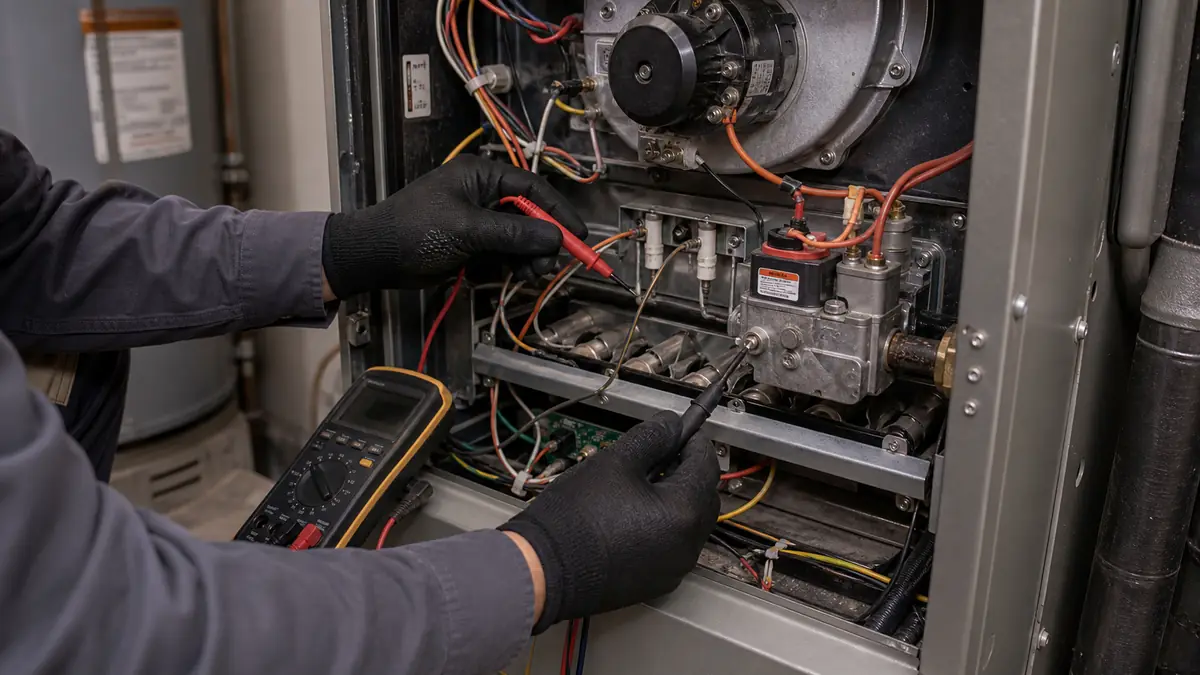
We work from the cheapest, most common cause outward, confirming each with a reading rather than a hunch. First we pull and inspect the filter and look for closed or blocked registers, because a single restriction explains most calls. Then we put a manometer across the air handler and read external static pressure; a Carrier furnace is rated for roughly 0.5 inches of water column, and a reading well above that proves the duct system is the choke point. We measure the temperature rise across the furnace - supply minus return - and compare it to the rise range stamped on the rating plate; a rise above the listed band confirms the air is moving too slowly to carry the heat. We inspect the blower wheel for caked dust that robs CFM and check that the ECM or PSC blower spins up to speed. Only after airflow is verified do we test the high-limit switch itself with a meter, because a switch that opens early - below its rated trip point - will lock out a furnace that is otherwise breathing fine. Each reading either clears a suspect or names it, so the repair targets the real fault.
What can I safely check before calling a pro?
A short, safe list. Replace the air filter with the correct size and a low-to-moderate MERV - a dense filter on an old return can itself cause a 13. Walk the house and open every supply register and confirm the return grille is clear of furniture or rugs. Make sure the furnace door panel is fully seated, since a loose panel trips the door switch and muddies the symptom. Then cut power at the switch or breaker for 30 seconds to reset the lockout and let it run a full cycle. If it completes, you found it. Where to stop: do not open the burner compartment, do not jumper or bypass the high-limit switch, and do not keep resetting a furnace that re-locks - a switch, blower, or duct problem needs instruments and is where we take over.
What does a Carrier 13 fix cost, and when is it urgent?
Cost tracks the cause. A filter-and-register correction or a blower cleaning lands in the roughly $150 to $600 range; a high-limit switch that has failed open runs about $150 to $350 installed. The urgency is moderate, not an emergency in most cases - the lockout is the furnace protecting itself, so you are not in danger sitting with no heat for an evening, and Burbank winters are mild enough that a same-week visit usually suffices. It becomes urgent on two conditions: if you smell anything hot or scorched, or if the limit keeps tripping even with a clean filter and open registers, because a heat exchanger running repeatedly past its limit is the one part you do not want to gamble. If a 13 keeps coming back after the obvious airflow fixes, treat it as a call, not a reset. Pair this with our maintenance plan so the filter and blower get checked before the first cold morning, or read the full Carrier code guide if your furnace is flashing more than one number.
Common questions
What does a 13 code mean on a Carrier furnace?
It is a high-limit-circuit lockout. The furnace overheated and the high-limit switch opened to shut off the burners; when that happens repeatedly within one call for heat, the control board stops retrying and flashes 13. The lockout itself is the safety working correctly - the real problem is whatever made the furnace run too hot, which is almost always restricted airflow.
Can I fix a Carrier 13 code myself?
Sometimes the first step, yes. Swap in a clean filter, open every supply register, and confirm nothing is blocking the return grille, then cut power for 30 seconds to reset. If the furnace runs a full cycle without re-locking, a clogged filter was the cause. If it trips again, stop - a blower, limit switch, or duct restriction needs a meter and is not a homeowner repair.
How much does a Carrier 13 code cost to fix in Burbank?
If it is airflow, the fix runs roughly $150 to $600 - a filter and register correction at the low end, a blower-wheel cleaning or minor duct work higher up. A failed high-limit switch itself is about $150 to $350 installed. We give the price after the static-pressure reading tells us whether it is airflow or the switch, so you are not paying for parts you do not need.
Will a 13 lockout damage my Carrier furnace?
Not immediately - the lockout exists to prevent damage by cutting the burners before the heat exchanger overheats. But ignoring it and resetting over and over runs the exchanger hot cycle after cycle, which stresses the metal over time and can shorten its life. Fixing the airflow promptly is both the cheap move and the one that protects the most expensive part in the furnace.
Related: all Carrier error codes, Carrier furnace not heating, and the Carrier 14 ignition lockout.