Carrier 14 Code (Ignition Lockout) in Burbank
Fast take: A Carrier 14 code in Burbank, CA (ZIP 91504) is a hard ignition lockout - the furnace tried to light, never proved a flame, and shut down on safety, with a worn igniter or a dirty flame sensor leading the suspect list; call (213) 277-7557 or book online for a same-week fix.
By the numbers
- Code 14 = hard ignition lockout after the furnace exhausted its ignition retries.
- Top causes: worn hot-surface igniter, dirty flame sensor, or no gas at the burners.
- Components in play: hot-surface igniter, flame sensor, gas valve, control board.
- Igniter or flame-sensor repair about $150-$400; a gas valve runs higher.
- Most common on the first cold Burbank mornings after a furnace sat idle all summer.
- Service area 91501, 91502, 91504, 91505; hours Mon-Sat 7am-7pm; emergency calls anytime.
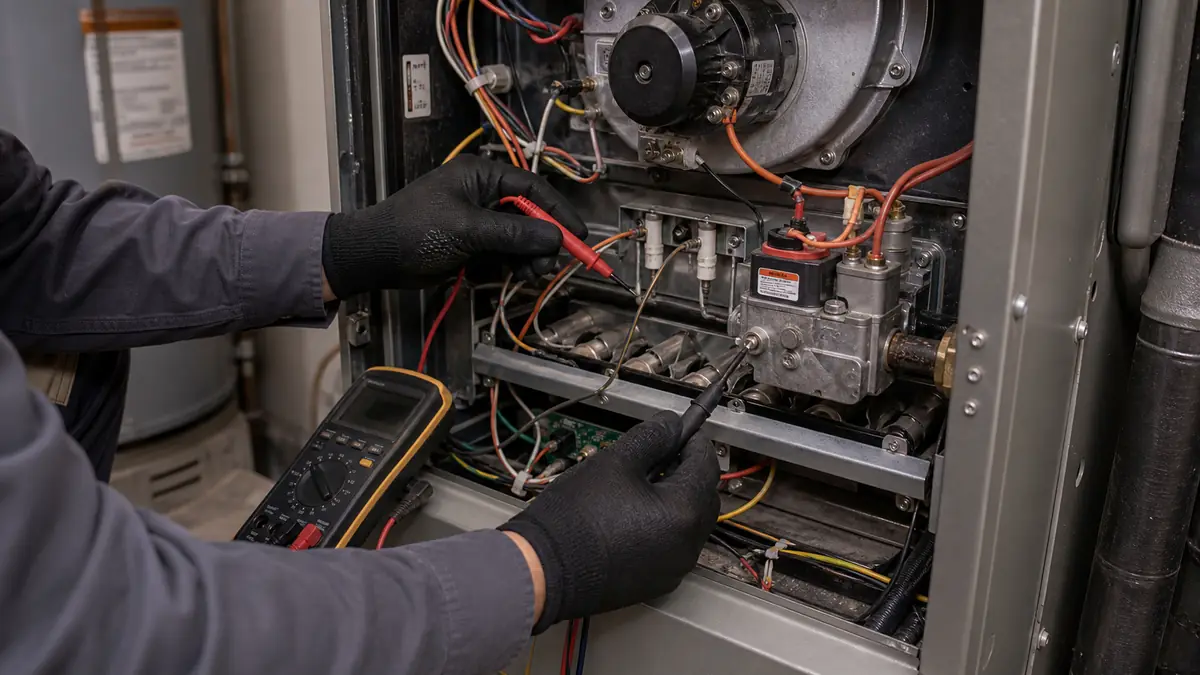
What does a Carrier 14 code mean on the furnace?
The 14 is a hard ignition lockout - the furnace gave up after trying and failing to light safely. Carrier furnaces ignite on a strict script. The inducer proves draft, the hot-surface igniter heats to a bright glow, the gas valve opens onto that glow, and within a couple of seconds the flame sensor must read a small flame-rectification current to confirm a real fire. If the igniter never gets hot enough, if no gas arrives, or if the flame lights but the sensor cannot confirm it, the board pulls the gas, waits, and retries - usually up to three times. When the last retry fails, it stops trying entirely and flashes 14, leaving the gas valve closed. That is the key thing to understand: a 14 is the furnace choosing not to keep throwing gas at a fire it cannot verify. So the repair is never "reset and hope." It is finding which link in the ignition chain broke, because the board has already proven it will not light on its own.
Why does my Carrier furnace lock out on 14 in Burbank?
Mostly because it sat unused. Burbank's Climate Zone 9 position on the southeastern San Fernando Valley floor means furnaces run only a handful of weeks a year, and a furnace that idles from March to November is a furnace whose ignition parts quietly degrade in place. A hot-surface igniter that was marginal last spring finally cracks or loses its glow on the first 45-degree morning. A flame sensor slowly grows an oxide film that blocks the tiny microamp current it needs to confirm flame - the rod is fine, but it has gone electrically blind. In the older Magnolia Park and Rancho Equestrian District cottages, those parts are often original to a 20-year-old 58-series furnace and overdue. Newer Burbank Hills rebuilds running 59-series condensing or Infinity equipment lock out for the same reasons plus one more: a long-idle condensate trap or a marginal gas-pressure delivery can starve the burners just enough to fail the proving window. And every fall we see the seasonal spike - the first genuinely cold week, when every furnace in town is asked to light at once and the weak igniters all fail together.
How do you diagnose a Carrier 14 lockout step by step?
We walk the ignition chain in order and let the meters decide. First we confirm the upstream steps actually completed - the inducer ran and the pressure switch closed - so we know the board reached the ignition stage rather than stalling before it. Then we watch one full ignition attempt with the panel off. We clock the hot-surface igniter and read it for resistance and a true bright glow; an igniter that reads open or barely warms is the answer, and it is the single most common one. If it glows but the furnace still locks out, we put a microamp meter in series with the flame-sense lead and read the rectification current the instant flame should appear - a healthy Carrier signal sits around 4 to 6 microamps, and a sooted sensor reading under 1 explains a 14 perfectly. We confirm the gas valve energizes and check manifold and supply pressure, because no gas or low gas fails ignition no matter how good the igniter is. We verify the burner ground, since flame rectification needs a solid ground path. Each reading clears or convicts a part, so we replace exactly what failed.
What can I safely check, and when is a 14 urgent?
The safe checks are short. Confirm the gas is on - check the appliance shutoff valve and that other gas appliances like the water heater or range still light, which rules out a utility-side outage. Make sure the furnace door panel is fully seated so the door switch is closed. Reset power for 30 seconds and watch one attempt; if it lights and runs, a single bad cycle may have tripped it. Where to stop: the igniter, flame sensor, gas valve, and burners are not homeowner parts, and you should never bypass a safety or keep forcing retries. On urgency - a 14 is rarely an emergency because the furnace has safely shut the gas, so on a mild Burbank evening a same-week appointment is fine. Move faster if you have no heat during an actual cold snap, if a vulnerable household member needs heat, or if you smell gas at all - a gas odor is a stop-everything, ventilate, and call situation, not a furnace-troubleshooting one. For anything past the simple checks, the fix is a technician with a meter; see the full Carrier code guide or our no-heat walkthrough if other symptoms came with it.
Common questions
What does a 14 code mean on a Carrier furnace?
It is a hard ignition lockout. The furnace ran its full ignition sequence, never sensed a stable flame within its allowed retries, and shut the gas valve for safety - then flashed 14 instead of trying again. The cause is somewhere in the ignition train: a worn hot-surface igniter that no longer glows hot enough, no gas reaching the burners, or a flame sensor too dirty to confirm the flame that did light.
Is a Carrier 14 ignition lockout dangerous?
The lockout itself is the safe outcome - it closes the gas valve rather than dumping unburned gas, so a furnace sitting on a 14 is in its protected state. The thing to respect is repeated manual resets. Forcing a furnace to retry ignition again and again can push a little raw gas into the heat exchanger before each attempt, so reset once to confirm the fault, then leave it and call rather than cycling it for an hour.
Can I clear a Carrier 14 code myself?
You can reset it - cut power for 30 seconds and confirm the gas is on at the appliance shutoff and the meter. If the furnace lights and runs, a one-time hiccup may have caused it. If it relocks on 14, stop there: the igniter, flame sensor, and gas valve are metered, not guessed, and the gas side is not a homeowner repair. Read us the code and we usually know which part before arriving.
How much does a Carrier 14 code cost to fix in Burbank?
Most 14 lockouts are an affordable part. A hot-surface igniter or a flame-sensor clean or replacement runs about $150 to $400 installed, and those two account for the large majority of 14 calls we see in Burbank. A gas valve or a control board, if the meter points there, costs more. We diagnose with instruments first so the quote names one part, not a stack of maybes.
Related: all Carrier error codes, Carrier furnace not heating, and the Carrier 13 limit lockout.